
Magine Pro and Accedo One launch Leyra
For over ten years, Magine Pro has helped broadcasters, media companies and operators launch and grow their streaming services with a powerful end-to-end OTT platform.
Today, we are excited to share the next step in that journey.
Magine Pro and Accedo One have come together to launch Leyra, a new OTT platform designed to support streaming services across their full lifecycle, from launch through long-term growth.
Leyra brings together the strengths of both companies. Magine Pro contributes its proven end-to-end platform for managing and operating streaming services, while Accedo One adds its marketplace ecosystem that allows operators to integrate additional services and technologies as their needs evolve.
Together, this creates a platform that combines operational stability with flexibility, helping streaming operators adapt, expand capabilities and continuously improve their services over time.
The launch of Leyra also brings together the experienced teams behind both platforms. Engineers, product specialists and customer teams who have spent years working alongside operators will continue supporting existing services while building the next generation of the platform.
Supporting the next phase of streaming growth
The streaming industry continues to evolve rapidly. Launching a service is only the first step. Platforms must continually improve discovery, engagement, monetisation and user experience in order to remain competitive.
Leyra has been created with this reality in mind. By combining Magine Pro’s experience operating full OTT platforms with Accedo One’s open ecosystem and marketplace approach, the platform is designed to evolve alongside the services built on it.
This allows streaming operators to introduce new capabilities, integrate new technologies and adapt their platforms over time without needing to rebuild their core platform.
What happens next
The launch of Leyra marks the beginning of the next phase for the teams behind Magine Pro and Accedo One. Work is already underway to bring the OTT platforms closer together, with new integrations, capabilities and product developments planned in the coming months.
You can learn more about the vision behind the platform and how Leyra supports streaming operators in our full introduction: Welcome to Leyra.
You can also explore the website at Leyra.com or follow Leyra on LinkedIn for regular updates.
Accedo and Magine Pro agree to merge SaaS businesses
Stockholm, Sweden, 2 December, 2025 – Global provider of video streaming software and services, Accedo, and OTT platform provider, Magine Pro, have signed a binding agreement to carve out and merge their respective SaaS businesses Accedo One and Magine Pro into a new jointly owned company.
The merger will create a global leader in SaaS solutions for OTT streaming, by combining Accedo One’s team and platform with those of Magine Pro.
Michael Lantz, CEO, Accedo, commented: “I’m thrilled to be joining forces with Magine Pro. Our customers expect us to lead product innovation and continue to drive the best experience both for them and the end user. Together with the talented team from Magine Pro, we will be able to focus our resources on growth and innovation.”
Matthew Wilkinson, CEO, Magine Pro, added: “With the maturing market for streaming, we believe that the winners will be the companies that can best help customers build thriving OTT businesses. Accedo is an ideal partner to create a joint venture with Magine Pro, given their global reach, mature tech stack and headquarters in Stockholm, Sweden.”
The new entity will start operating following customary regulatory approvals which are expected in December 2025. Markus Hejdenberg, current CEO of Accedo One, will step into the CEO position of the new company, while Matthew Wilkinson, current CEO of Magine Pro, will become Chief Commercial Officer. Kamal Bherwani will be appointed to Chairman of the board. The new entity will operate separately from the Accedo Group but utilize Accedo’s global network, resources and reach as a key business partner and reseller of products and solutions.
Kamal Bherwani, Chairman of the new entity, added: “This joint venture marks a pivotal moment for the streaming industry. By uniting the strengths of Magine Pro and Accedo One, we are creating a company with the scale, expertise, and ambition to redefine SaaS solutions for OTT streaming worldwide. As Chairman, I look forward to guiding this new organisation as it accelerates innovation, empowers customers, and sets new standards for growth in a rapidly evolving market.”
-ENDS-
About Accedo
Accedo is a global provider of award-winning software and services to optimize, grow, and evolve video streaming services. Our expert teams have helped many of the world’s leading video companies – including Paramount, Deutsche Telekom, ITV, Hallmark, BBC, Cogeco, and Tata Play – become more competitive. Our offerings range from the no code Accedo One platform to complete OTT managed services, always backed by a data-driven approach and with the end user experience in mind.
Accedo was founded in 2004 and is headquartered in Stockholm, Sweden with 15 global offices across the world.
Website: www.accedo.tv
LinkedIn: https://www.linkedin.com/company/accedo-tv/
Media Contact:
Helen Weedon
Communications Manager, Accedo
+44 1570 434632
helen.weedon@accedo.tv
About Magine Pro
Magine Pro is a leading end-to-end SaaS platform for OTT streaming that enables studios, content owners, and media companies to launch and scale professional video services globally. Built on history of operating its own direct to consumer services, and over a decade of proven expertise in streaming technology and operations, Magine Pro provides a fully managed solution, one-stop-shop solution with advanced monetization capabilities, configurable applications, video CMS, localization for multiple markets, for all media types (VOD, Live, FAST, Linear/Broadcast) and operational tooling to support B2C streaming services scale & distribute effectively.
Magine Pro was founded in 2011 and is headquartered in Stockholm, Sweden.
Website: www.maginepro.com
LinkedIn: https://www.linkedin.com/company/magine
Media Contact:
Hayley Barnes
Head of Marketing & Communication, Magine Pro
+44 7989 476 491
hayley.barnes@magine.com
When Complexity Kills Creativity: The Hidden Cost of Too Many Vendors in OTT
Does anyone start a streaming service because they’re passionate about the underlying technology? Unlikely. Most specialist streaming services begin with a love of content, a belief that a particular collection of stories deserves a home and a community built around it. But somewhere along the way, many operators find themselves spending more time managing vendors, integrations and technical firefighting than curating great content or serving their audience. It’s all too easy for a team built around creativity to end up running what feels like a mini IT department.
And this isn’t just an OTT problem. One survey of over 140 CIOs, executives in large enterprises with far more resources than most specialist streaming services, named vendor consolidation as their top strategic priority for 2025. Nearly 70% planned to reduce the number of suppliers they work with, in some cases by more than 20%. Their reasons are familiar: security, fragmentation, operational complexity and lack of cohesion across systems. If organisations with entire IT departments and security teams are actively trying to reduce complexity, the case for consolidation among smaller, content-led services is even stronger.
The Hidden Operational Tax of Best-of-Breed
The idea of “best-of-breed” technology remains seductive. Pick the best vendor for each piece of your stack, and you end up with a world-class platform, at least in theory. But in practice, especially for teams without layers of programme managers and architects, the operational cost quickly becomes overwhelming.

Magine Pro’s Head of Engineering & Operations, Marcus Lindén, has lived this reality from both sides, first at TV4 in Sweden and now as a vendor helping specialist services scale. As he puts it: “Working best of breed, you get exactly what you want, of course, but you need a big team to manage all of these vendors. If you’re on the big broadcasting side, the way to solve the complexity is to build up a big internal organisation — a hundred plus engineers working around the clock, but then you still keep all the external vendors as well. You have to coordinate the work. Even though every vendor does their best, you still need layers of programme managers and project managers just to get things done.”
Every additional vendor brings its own roadmap, requirements, timelines and integration points: each moving at its own pace. And when something breaks, accountability gets blurred very quickly. The result is an ongoing “operational tax” that eats into the time and focus needed to understand your audience, acquire great content and refine your service.
As we explored in our recent blog on operational context loss, multi-vendor setups often create gaps between systems that slow down decision-making and make it harder to run an OTT service confidently. Complexity causes delays, but also drains energy from the places where it’s most needed.
End-to-End Platforms: One Partner, One Place to Run Your Service
 This is where an end-to-end approach has clear value: fewer vendors to manage, fewer handovers, and far less room for gaps in understanding or responsibility. When Magine Pro’s CEO, Matthew Wilkinson, talks about the impact this has for operators, he brings the conversation back to clarity and accountability. “If you work with lots of individual suppliers, they’re very siloed. They focus on what they do, but they may not be taking into consideration the end-to-end chain. At Magine Pro, we handle the end-to-end chain, so there’s a one-stop shop for fixing problems. You don’t need to go to one vendor who points to another, who points to another.”
With an all-in-one platform, operators gain a single operational view of their content catalogue, user lifecycle, billing, product configuration and performance. There’s no guesswork about where something lives or whose system needs to be updated.
Magine Pro’s Console is central to that simplicity. It brings together the everyday tasks that keep an OTT service running: managing catalogue items, setting up service plans, monitoring churn signals, supporting customer journeys and controlling billing, all in a single interface. For specialist services such as Passionflix, Splatter or Filmicca, this frees up the time and headspace needed to focus on the audience and the stories that matter to them.
Agentic Coding: Speeding Up Innovation Without Increasing Workload
Of course, simplicity alone doesn’t solve the competitive challenge. Specialist streaming services still need to move quickly. They must continue launching new features, adapting to viewer behaviour and staying on par with the global innovators like Netflix or Disney+ who set audience expectations.
This is where Agentic coding has reshaped the pace of development within Magine Pro’s engineering teams. It’s not about bolting on eye-catching AI features; it’s about accelerating the entire cycle from idea to customer feedback. As Matthew explains, “Before, we may have taken a couple of months to get a big new feature out and then get the customer feedback. Now, you can do that in a matter of days.”
“Early customer feedback is always helpful,” agrees Marcus. “Being able to get mockups, prototypes and test versions into their hands quickly makes a real difference.”
For specialist streaming services, this speed creates a more responsive, less resource-intensive way to evolve. Teams don’t need a large internal engineering function to keep pace with change; they need a partner who can deliver improvements quickly and consistently.
Security: The Quiet Risk Behind Vendor Sprawl
The CIO research that highlighted vendor consolidation also pointed to another growing concern: security risk increases with every supplier added. Each integration introduces its own permissions, tokens, maintenance windows and vulnerabilities.
For specialist streaming services, security threats, from piracy to credential theft, are business-critical and something they’re unlikely to be equipped to tackle in-house. As Marcus explains in his deep dive into OTT security, protecting a platform requires consistency, oversight and clear responsibility. Those things are far harder to maintain when systems are distributed across multiple vendors. “In a smaller service provider, there are fewer resources”, says Marcus. “The problem we solve for them is that they don’t need additional resources to manage us. They’ve got one interface to handle everything.”
Simplification should be a core OTT security strategy.
Creativity Thrives When Complexity Doesn’t
Specialist streaming services succeed when they can focus on what makes them unique: the content they champion, the editorial choices they make and the communities they build. But that only happens when teams have the space to think, experiment and create. Complexity shrinks that space; simplification opens it back up.
End-to-end platforms like Magine Pro, combined with unified operational tools and Agentic development, give streaming services the freedom to concentrate on their core strengths, rather than the machinery behind the scenes.
If you want to hear Matthew and Marcus discuss these themes in more depth, watch the full conversation between them here.
Or, if you’d like to talk to our team about how Magine Pro helps specialist streaming services focus on what they do best, book a meeting with us here.
When Netflix Simplifies, Every OTT Operator Should Pay Attention
Over the summer, Netflix rolled out one of its biggest TV experience updates in years, and the message behind the redesign was loud and clear: People don’t want more choice. They want an easier choice.
Bigger artwork. Fewer options on screen. Clearer navigation. A personal hub. Responsive recommendations. All designed to try and solve one of streaming’s biggest (and quietest) problems: decision fatigue. Smaller-scale OTT services should take note because if even Netflix is simplifying, it’s because complexity doesn’t convert.
We’ve been talking about this shift for a while. In fact, Magine Pro CEO Matthew Wilkinson wrote about the ‘Paradox of Choice’ back in 2023, highlighting how too many good options can cause cognitive overload and lead to churn. What we’re now seeing from Netflix is exactly what he predicted: a stronger focus on Decision Experience (DX), not just recommendation algorithms.
And Netflix’s move validates something we see every day among niche and mid-sized OTT services: There is real business value in helping people make decisions faster, not just offering more options.

Decision Fatigue: The Silent Churn Driver
There’s a particular frustration in sitting down to be entertained and spending the next ten minutes choosing instead. Not because there’s nothing good, but because everything is fighting for attention at once. And in that moment, when the browsing becomes a chore, viewers drift.
And decision-making is even harder on the big screen. Why? Because it’s often a shared decision. Two or three people. One remote. Different tastes. A longer content commitment. A simple choice becomes a negotiation, and the longer it takes, the more the moment slips away.
For smaller OTT services, these moments matter even more. You don’t have the brand gravity of Netflix to keep people trying again tomorrow. A cluttered homepage or slow discovery flow can cost you a subscriber long before you notice it in the analytics.
What Smaller OTT Operators Can Learn from Netflix
Here are three strategic takeaways from Netflix’s redesign – all achievable without Netflix-sized budgets:
1. Simplify navigation relentlessly
If viewers need a map to understand your menu, it’s already too complex. Clear, predictable navigation dramatically reduces “Time to Decision,” getting viewers into content faster – one of the strongest predictors of first-session engagement. This is why our Smart TV UX guide emphasises simple pathways, shorter journeys, and navigation that “just makes sense.”
2. Prioritise a clean, calm homepage
Big artwork. Fewer rows. Consistent patterns. The goal isn’t to showcase everything; it’s to highlight the right things in the right moment.
We regularly see operators improve first-click time and overall session length simply by removing visual noise. With the Magine Pro CMS Console, even small layout tweaks or targeted curation can produce a noticeable lift – all without a full rebuild.
3. Use data to serve smarter, not more
Netflix’s approach is simple: show fewer options, but show better ones. Smaller OTT services can absolutely do the same. The key is using your data to shape the homepage rather than stuff it. Pay close attention to analytics, especially:
- What’s popular and keeping viewers engaged
- What’s tailing off and could move to a less prominent spot
- What’s under-watched because it isn’t visible on the homepage
- What new users click on first
When you curate intentionally, even a small catalogue feels bigger and more engaging and good curation will always beat endless rows.
How Magine Pro Helps Operators Compete Without Competing on Scale
You don’t need Netflix-level engineering to deliver a smoother, smarter UX. You just need the right foundations.
At Magine Pro, we’ve seen how simple changes, such as faster sign-ins, cleaner layouts, consistent cross-device experiences, curated content rows, and more streamlined content journeys, can significantly increase engagement and reduce churn.
And we’ve packaged our best learnings into a set of practical resources:

4 Ways to Help Audiences Find Their Next Favourite Show
A one-pager packed with quick wins for improving discovery without adding complexity. Download it here.
Are Your Smart TV OTT Apps Up to Scratch?
A one-stop guide to navigation, onboarding, accessibility, and performance essentials for big screens. Download it here.
Behind the Screens: Crafting Immersive UX/UI for Streaming Services
A deeper dive into decision-friendly UX principles and real-world platform design strategies. Download it here.
The easier you make it for viewers to choose what to watch, the longer they stay. And the operators who embrace simpler, calmer, more curated UX will be the ones who win attention and retention, in 2026.
If you’d like support reviewing your current big screen experience, refining discovery, or improving engagement through the Magine Pro Console, we’re always here to help. Get in touch with our team to book a demo and explore how our powerful CMS and end-to-end OTT platform today.
The Simple Fix That Keeps Viewers Watching: Smarter Content Discovery for Streaming Services
We’ve all been there, scrolling endlessly through a streaming app, trying to decide what to watch next. Five minutes later, the excitement fades, and you end up watching something you’ve seen before or switching to another app in frustration. For viewers, that’s fatigue. For streaming services, it’s a quiet but costly loss of engagement.
In today’s crowded OTT market, how people find content has become just as important as the content itself. If discovery feels slow, inconsistent, or cluttered, audiences switch off, sometimes literally. And that’s where retention quietly slips away, turning minor UX issues into major business challenges.
At Magine Pro, we’ve seen how small changes in user experience can have a huge impact on engagement and revenue. A smoother sign-in, faster updates, or more intuitive navigation can be the difference between a subscriber staying or churning. The good news? These improvements don’t require reinventing your platform, just rethinking how you use it and what your viewers truly need.
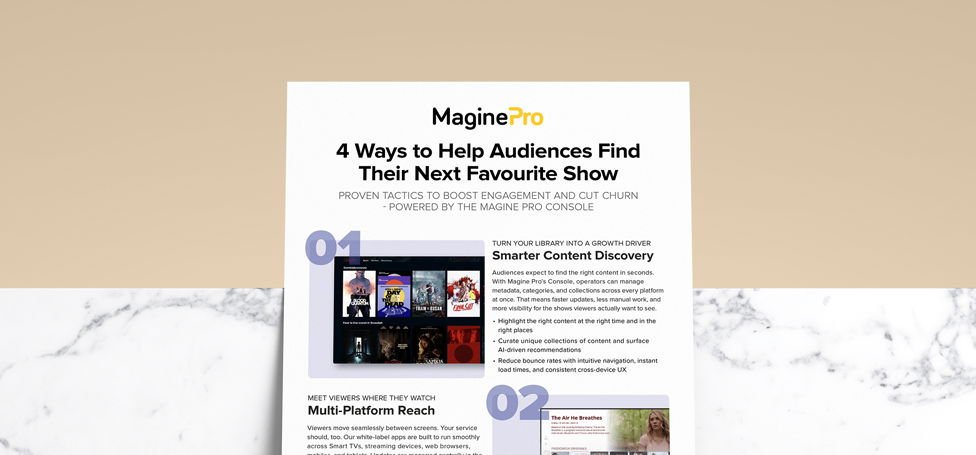
That’s why we’ve put together a quick guide: “4 Ways to Help Audiences Find Their Next Favourite Show.” It’s a short, practical read designed for operators who want to boost engagement and reduce churn without adding complexity. The guide shares proven strategies drawn from real Magine Pro customers, showing how smarter discovery, cross-platform consistency, actionable data, and flexible monetisation can all work together to keep viewers watching longer.
Whether you’re running a niche streaming service or managing a global audience, this one-pager is packed with insights you can act on today.
If you’re ready to see how the Magine Pro platform and Console can help you launch faster, simplify operations, and grow smarter, we’d love to show you more. Get in touch with our team to book a demo and explore how our powerful CMS and end-to-end OTT platform can help your viewers find their next favourite show.
Efficiency, Scalability & Agentic AI: Inside Magine Pro’s Vision for the Future of OTT
How do you keep innovating in OTT when every new feature risks adding more complexity? It’s a crucial question for any video service that’s weighing up the pros and cons of different OTT platforms.
With decades of OTT experience between them, in both vendor and broadcaster roles, Magine Pro’s CEO, Matthew Wilkinson, and Head of Engineering & Operations Marcus Lindén, have seen plenty of innovation in the space.
So when they sat down to discuss how the next generation of OTT services will be built, we knew they’d have plenty of opinions on what it takes to balance speed, scalability, and innovation in a changing market. You can watch the video of them in conversation at the bottom of this blog.
Buy vs Build: The age-old debate comes of age in the cloud era
Drawing on their combined experience across broadcasting, product, and engineering, and Marcus’s background working with one of Sweden’s biggest broadcasters, the conversation touches on the continuing debates between best-of-breed and end-to-end platform strategies. While best-of-breed architectures allow operators to select specialist vendors, they can also add layers of complexity, product management, and cost. Watch the video to learn how Magine Pro’s integrated approach reduces that overhead, helping operators launch, manage, and evolve their services faster, with one partner accountable for the full OTT chain.
Agentic Coding: More than just the industry’s next buzzword
The discussion also highlights how Magine Pro is harnessing Agentic AI to transform its engineering workflows. Rather than adding isolated AI features, the team is applying Agentic coding to accelerate the entire product lifecycle: moving from concept to customer feedback in days instead of months. This approach enables faster iteration, continuous improvement, and earlier delivery of new functionality.
What’s Next From Magine Pro?
Finally, Matthew and Marcus reveal how the upcoming evolution of Console, Magine Pro’s orchestration and admin tool, will give operators more context and control. From catalogue management and billing to user engagement and churn prevention, Console puts actionable insights and configurability at the heart of every OTT service.
Watch the full video conversation below:
Want to continue the discussion with our team? Why not book a meeting to discuss how the Magine Pro OTT platform can help you redefine efficiency in your OTT operations?
The Hidden Cost of Context Loss in OTT Operations
Every OTT team aims to move fast. But speed alone isn’t enough if teams are constantly forced to stop, clarify, or rebuild missing information. One of the most overlooked barriers to operational efficiency in streaming is context loss: the gradual erosion of meaning as work passes between tools, teams, and systems.
It’s a challenge we hear about often from streaming companies of all sizes. Whether it’s a content issue, a billing query, or a technical fault, too much time is lost piecing together the full picture. Context, which should flow naturally through workflows, is often scattered, outdated, or inaccessible.
This blog explores how context loss undermines efficiency and what a modern OTT platform can do to fix it.
How Context Disappears
Context is what allows people to make decisions quickly and confidently. It’s not just data, it’s the meaning behind the data. And in most OTT operations, that meaning gets diluted every time there’s a handoff.
A support ticket might start with a user reporting a playback issue. But for the support agent to understand what really happened, they need to access subscription status, device logs, network diagnostics, and content metadata. Each of these is typically stored in different places. The information exists, but it isn’t connected. So they rebuild the story manually.
This happens across departments too. When you have a new movie or episode to put live, there will be concerns about metadata and artwork, but also video files to encode, not to mention negotiations and checks on platform rights and licensing windows. For all but the very smallest streaming services, this is the work of several different people or teams. They’re working toward the same goal, but each sees the task through a different lens. Without shared context, assumptions multiply and momentum slows.
The Cost of Fragmented Tools
Many OTT services work with a stack of systems that weren’t designed to talk to each other. CDNs use one set of metrics, CMS tools use another to track content through the supply chain, and the analytics platform also has its own figures. Support systems log issues using another taxonomy entirely. These systems may all function well in isolation, but they create friction when progress depends on information that spans them.
When teams have to translate between systems, decisions become slower and riskier. Even worse, they’re often made based on incomplete or inconsistent views of what’s really happening.
Rebuilding Context Takes Time
The real cost of context loss is cumulative. A product manager double-checks metadata. A QA team revalidates assets before delivery. A support team replays the same investigation multiple times for similar tickets. These tasks feel necessary, and often they are, but they’re also symptoms of a deeper problem: context isn’t preserved or delivered in the right way.
Over time, these small inefficiencies add up to slower launches, higher support costs, and internal frustration. Teams spend too much time looking backwards, reconstructing what should already be at their fingertips.
What a Good Platform Can Do
A well-designed OTT platform should help preserve and deliver context throughout the content and customer lifecycle. This doesn’t mean centralising all data in one dashboard. It means making sure each team sees the right information, in the right format, at the right time.
That might include showing support agents a timeline of relevant events for a customer issue. Or helping publishing teams to view content status with licensing, technical, and editorial flags in one place. The goal is to reduce manual effort and eliminate the guesswork that comes from working with partial information.
Where AI Fits In – And Where It Doesn’t (Yet)
There’s no shortage of AI conversation in the streaming space – IBC 2025 showed that artificial intelligence is still the industry’s biggest buzzword. But in our view, the most practical and valuable use of AI is in helping teams work with better context.
Imagine an AI assistant that notices five customers reporting similar playback issues, and correlates them with a spike in edge latency on a specific CDN node during a particular device rollout. That kind of correlation saves time and directs teams to the real issue faster.
This doesn’t mean replacing human decision-making. It means using AI to highlight patterns, reduce noise, and make it easier to see what’s important. At Magine Pro, we’re focused on adding AI tools that support context awareness, but we’re not forcing automation into our OTT platform for its own sake.
Turning Context into Competitive Advantage
Preserving context isn’t just about speeding up operations. It also improves decision quality, reduces churn, and enables teams to focus on higher-value work. When context flows smoothly across your organisation, your platform becomes easier to manage, problems are resolved faster, and teams make better use of their time. That frees up your staff to focus on your strategic priorities, like tackling subscriber churn and boosting user retention.
As OTT services scale, this kind of efficiency becomes essential. The complexity doesn’t go away, but with the right platform, the burden of managing that complexity doesn’t have to slow you down.

For a deeper dive into how context becomes king in OTT, and why context is sometimes more important than content, read the original article our CEO, Matthew Wilkinson, wrote for the IABM Journal in September 2025 on page 104, exploring how context-aware workflows can unlock smarter decisions across the entire OTT supply chain.
IBC 2025 Recap: AI, Efficiency, and What’s Next for OTT
September is always a big month in our calendar as the team heads to Amsterdam for IBC. This year, the show was buzzing with conversations that will define the future of streaming. Across panels, meetings, and chance encounters in the halls, two themes stood out above the rest: AI and efficiency.
On AI, the tone had shifted – less hype, more substance. Real-world use cases are starting to make a difference in content discovery, personalisation, and operational workflows. As our CEO, Matthew Wilkinson, explained, “Agentic coding lets us move from months to days for major features. There’s always a human in the loop, but the product life cycle accelerates dramatically.”
Efficiency was the other major focus, with operators looking to do more with less while maintaining a great viewer experience. It’s also an area we’ve been focusing on at Magine Pro. As Matthew noted, “We’ve completely re-engineered the console to give operators more context across their service, helping them move faster, make better decisions, and introduce more automation.”
At Magine Pro, we see these themes play out every day with the streaming services we support. Whether it’s helping niche brands scale globally or enabling established operators to launch new offerings quickly, the message is clear: efficiency is no longer optional; it’s essential.
Here are some of the highlights and takeaways from IBC 2025.
From the Stand to the Riverside
Our stand at IBC was buzzing with activity from start to finish. We hosted both scheduled and walk-in meetings, showcasing demos of our platform across multiple devices and walking visitors through our powerful CMS console. Conversations were wide-ranging, from launch strategies and monetisation models to how operators can deliver better experiences, faster, and at scale.
But IBC is always about more than what happens on the show floor. This year, we were proud to co-host an evening by the riverside at Rijnbar, celebrating innovation and collaboration with our partners Marketlyft, Lighthouse Growth, Stockholm Stream, and Bunny.net. It was a fantastic opportunity to step away from the bustle of the RAI, reconnect with familiar faces, and spark new ideas for the year ahead.


Sharing Industry Insights at IBC
Meanwhile, our CEO, Matthew Wilkinson, contributed to industry thought leadership in two key ways. His article, “Context is King”, was published in the IABM Journal, which you can now read online on page 104. He also joined an IBC panel with XRoadMedia and ADB SA on “Combatting churn through smarter engagement and personalisation,” where the discussion focused on practical ways streaming services can retain and re-engage subscribers.
The session explored how shifting viewing habits, subscription fatigue, and the rise of direct-to-consumer models are reshaping retention strategies. As Matthew explained, many services are now looking beyond short-term promotions to create lasting value: “Post-COVID we see subscription fatigue. The best thing to prevent churn in a subscription service is to get people to lock in and take a yearly subscription. When you have big shows and big releases, run campaigns around your content bundling and offering.”
The panel agreed that while content is still the biggest driver of loyalty, how it’s packaged, released, and promoted ultimately determines whether viewers stay engaged or switch away. You can watch the full discussion below.

IBC is only the start of the conversation. Next up, we’ll be in Cannes for MIPCOM, meeting content owners and operators to explore how we can help distribute exclusive content, launch branded streaming services, and grow audiences worldwide. If you didn’t catch us in Amsterdam, we’d love to see you in Cannes. Book a meeting here.
E-Guide | Are Your Smart TV OTT Apps Up to Scratch? Four UX Must-Haves for Big Screens
The direction of travel for in-home streaming is clear. While mobile still dominates short-form viewing, Smart TVs now reign supreme in the living room. By 2026, at least 50% of global households, or around 1.1 billion homes, are expected to own one.
But with sky-high demand comes equally high expectations. On Smart TVs, every second counts. If users struggle to log in, cannot find content quickly, or encounter clunky playback, they will leave and may not return.
That is why we have created our new free guide: “Are Your Smart TV OTT Apps Up to Scratch? Four UX Must-Haves for Big Screens.” Drawing on years of experience building and optimising Smart TV OTT apps across platforms like Samsung, LG, Android TV, and Vizio, we have identified the UX essentials that can make or break engagement with your service.
What You Will Learn in the Guide
In under 10 minutes, you will gain actionable insights into the four areas where OTT apps succeed or fail on the big screen:
-
Onboarding that converts. How to turn curiosity into commitment in under 60 seconds.
-
Navigation that just makes sense. Cut the friction and help viewers get to content faster.
-
Family-friendly and accessible UX. Why inclusivity is not optional and how to get it right.
-
Performance that delights. Optimise speed, reliability, and smooth playback to reduce churn risk.
You will also discover future-proof trends shaping Smart TV experiences so you can stay ahead of user expectations.
If you are a niche or mid-sized OTT service, you are already competing with streaming giants like Netflix, Disney+ and Amazon. You may not have their budgets, but with the right UX, you can deliver a polished big-screen experience that keeps audiences engaged.

Get the Free Guide
Smart TV apps are not just another device. They are the place where your service needs to shine. Small improvements to UX can translate into big gains in sign-ups, retention, and satisfaction. Download the guide now and learn the four Smart TV UX must-haves that can help your OTT app truly compete on the big screen.
Want to discuss your Smart TV strategy and how to improve engagement on the big screen? Contact us to start the conversation.
Follow Magine Pro on LinkedIn to stay up to date with our latest product news, announcements, and industry insights.
Magine Pro at IBC 2025: Demos, Discussions & Drinks
We’re gearing up for IBC in Amsterdam this September, and we’d love to see you there. You’ll find us in Hall 5, Stand D72, where our team will be showing how Magine Pro helps streaming services launch faster, scale globally, grow audiences, and monetise flexibly.
Whether you’re an operator, distributor, or content owner, we’re here to show how our flexible platform and expert team can help you simplify operations, reduce time-to-market, and unlock new revenue opportunities. Book a meeting with us at the stand to explore how we can help you.

Live Demos at the Stand
Throughout the show, we’ll be running hands-on demos of our OTT platform and CMS. You’ll also be able to explore the full user experience across devices, including Smart TVs.
Here’s what you can expect:
Distribute & Scale
Featuring seamless distribution to leading platforms and custom apps
See how Magine Pro enables seamless content distribution and scale with partners like Stockholm Stream and Lighthouse Growth, delivering to platforms such as Amazon Prime, Apple TV+, and Magine Pro. Our platform also supports the creation of refined custom applications, helping services reduce time-to-market, streamline global delivery, and expand easily across devices and destinations.
Smarter Operations with a Touch of AI
Featuring our enhanced CMS Console with smarter tools
A first look at our enhanced Console, designed to improve the user experience and make daily service management smoother. With a touch of AI working quietly in the background to automate repetitive tasks, surface insights faster, and give operators more time to focus on what matters.
Drive Customer Growth
Featuring the Referral Platform
Discover how one of our customers is using Magine Pro’s new in-platform referral tools to drive organic subscriber growth, boost fan engagement, and open new acquisition channels, without added development effort.
Adapt Revenue Models
Featuring Anonymous User Support, AVOD & FAST
Explore how Magine Pro enables flexible monetisation strategies. From hybrid subscription + ad tiers, to supporting anonymous viewers, to launching FAST channels, we’ll show you how to adapt revenue models to fit your audience and market.

Hear from Our CEO on Stage
Don’t miss our CEO, Matthew Wilkinson, on the panel “Combatting churn through smarter engagement and personalisation” on Sunday, 14 September, 10:15–11:00. He’ll be joined by industry leaders from XRoadMedia and ADB SA to discuss how streaming services can retain subscribers by delivering more personalised and engaging experiences.

Keep the Conversation Flowing: Drinks at Rijnbar
Saturday, 13 September, 17:30 – 19:30
Rijnbar, Amsterdam
Join us for an evening of good drinks, great company, and relaxed networking by the riverside. We’re co-hosting alongside our friends at Marketlyft, Lighthouse Growth, Bunny.net, and Stockholm Stream.
This is the perfect chance to connect with peers and partners shaping the future of media, streaming, and growth. Whether you’re an old friend or a new face, we’d love to welcome you.
RSVP here to secure your spot!
See You in Amsterdam
IBC is always one of the highlights of our year, and 2025 is shaping up to be bigger than ever. Come find us at Hall 5, Stand D72 to experience the latest in OTT innovation first-hand.
Book a meeting with our team in advance to make sure you get a slot that suits you.