
IBC 2018: The OTT Takeover Looms
The idea that OTT will eventually eclipse traditional delivery methods is nothing new, but after seeing some of the latest developments at IBC this year the cord cutting revolution may soon be complete! The industry is evolving rapidly and new tech developments have built new momentum. It’s certainly an exciting time to be apart of the industry and we’re eager to see what the year ahead has in store.
IBC has been considered the annual go to industry event since 1994, and is the leading exhibition and conference for media, entertainment, and technology. The event attracts professionals from around the world involved in content creation, management, and delivery. Here at Magine Pro, integral team members have been attending IBC for over 15 years and since launching Magine Pro in 2016 we’ve exhibited in hall 14.
On reflection of this year’s event, IBC 2018 gave a much better insight into the future of media streaming than we’ve seen before. In particular, how media streaming is evolving and what direction it may take in future. The Content Everywhere hall 14 was packed with vendors presenting much more commercially efficient streaming solutions. There was also an emphasis on diversifying of CDN and meta clouds – something we’ve expected for some time but they’re finally looking like real and viable alternatives.
There also appeared to be more solutions that can efficiently handle ingestion of large-scale broadcasts. Both AWS and Google showcased new products for this. The actual transition of legacy TV distribution is finally about to take place, or so it seems.
AWS, in particular, demonstrated new services that address the bottleneck issues for live streaming, namely how to ingest traditionally aired linear broadcasts in an optimized and more efficient way. And since it’s AWS, these services are already fully integrated into their ecosystem, allowing their existing partners to take advantage of them in existing deployments. For Magine Pro, it means we’re able to offer more efficient ingest services to our clients through the Magine Platform AWS environment.
Google and AWS are certainly eating their way into the IBC halls as both had much larger booths than in previous years. A sign of what’s to come no doubt and where the most interesting development will take place; the transition to the cloud – next years outspoken mantra.
Facebook was also present in the Content Everywhere hall this year but didn’t have as big a presence as we anticipated. They surprisingly seemed like a much smaller video tech entrant compared to the likes of Google and Amazon – now the video and media behemoths of IBC.
We found the speaking and panel session agenda at the Content Hub was particularly well balanced this year though with engaging topics and debates regarding the state of the industry and its future. Our Head of Commercial Operations, Fredrik Engdahl also took part in one of the sessions, ‘Telco TV: The Convergence of Broadcast and Telecoms’. If you missed it, you can catch up here.
We also showcased our branded OTT solutions and services for live, linear TV and VOD content on our stand in hall 14 . If you didn’t get a chance to stop by, you can find out more about our products here or download our latest white paper. Get in touch if you would like to learn more or try a demo.
We’ll be heading to Cannes for MIPCOM this month. If you’re attending and would like to meet with a member of the Magine Pro team, get in touch!
As for IBC, we’ll see you next year!
Telco TV: The Convergence of Broadcast and Telecoms
This week, we attended IBC in Amsterdam. IBC is one of the world’s most influential media, entertainment, and technology shows. The annual exhibition and conference brings together industry leaders from around the world to discover the latest innovation in technology and debate the current challenges and opportunities facing the electronic media and entertainment industry.
During IBC, Magine Pro’s Head of Commercial Operations, Fredrik Engdahl took part in the panel debate, ‘Telco TV: The Convergence of Broadcast and Telecoms’. If you missed the session on Monday at the Content Hub, don’t worry you can catch up below.
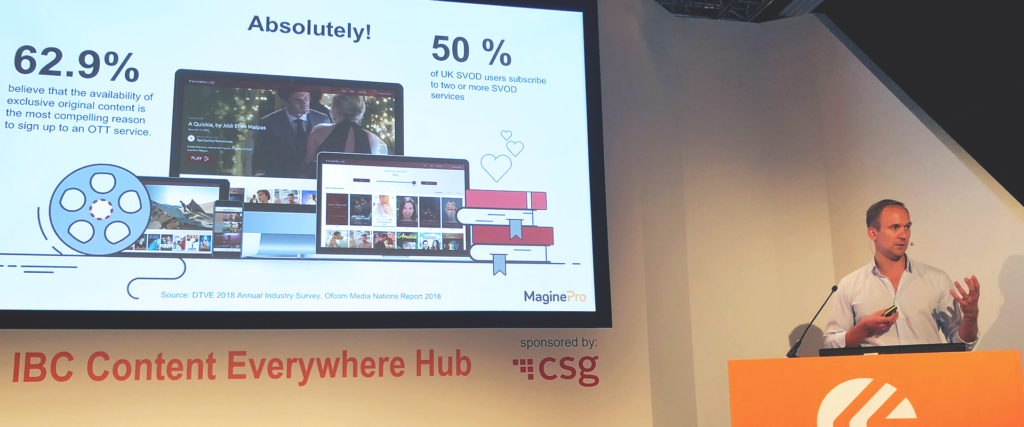
Fredrik presents his views on the current state of the industry and specifically how telcos can successfully move into the OTT market by either vertical integration or through partnerships. The panelists also debate the future of telcos in OTT and how through partnerships they can leverage each other’s strengths to provide the best customer experiences.
You can watch the session in full below.
You can also check out Fredrik’s latest blog post ‘Operators and OTT, live together in perfect harmony’ where he discusses the issue in more depth.
Operators and OTT, live together in perfect harmony
“The modern media company must develop extensive direct-to-consumer relationships, we think pure wholesale business models for media companies will be really tough to sustain over time.”
-AT&T Chairman-CEO Randall Stephenson during his latest investors call explaining his company’s vision of how to stay relevant to consumers in the fight against Netflix and Amazon, and the rationale behind AT&T’s acquisition of Time Warner.
Randall’s statement is understandable, as Mobile Operators today are feeling the pressure to find the next revenue growth driver. Over the last 10 years, Operator’s revenues have been in decline (as shown in the Northstream graph below), with investments (CAPEX) required for the growth of mobile data consumption remaining flat.
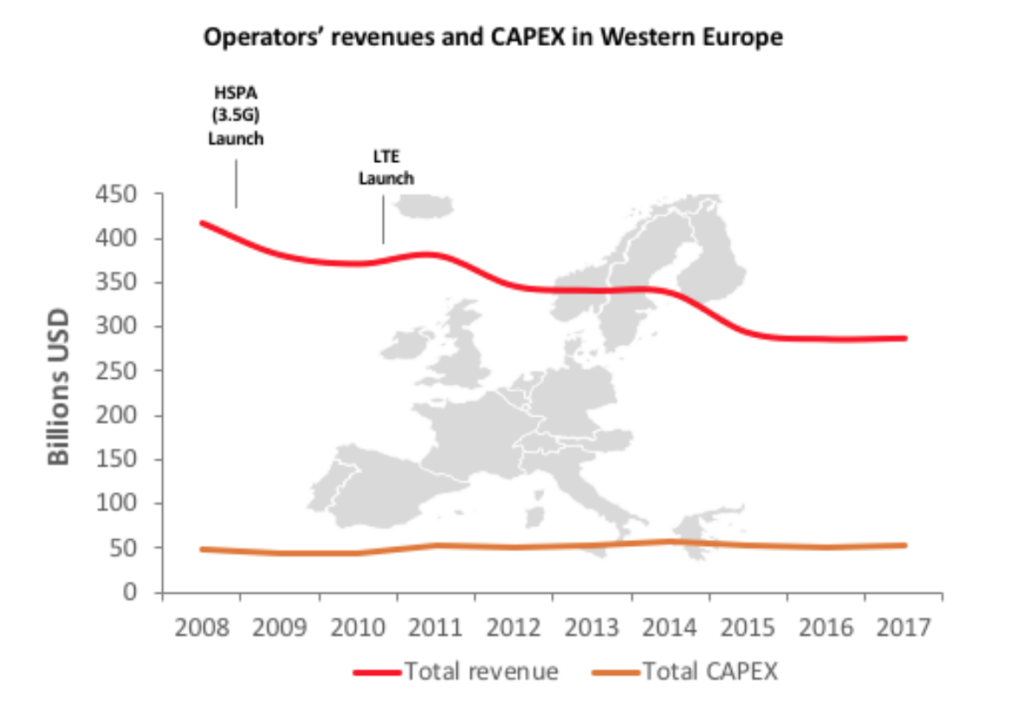
Source: Northstream
Vertical integration is the name of the game
As the graph below demonstrates, mobile data traffic is still showing tremendous growth, and with cord-cutting reaching new heights, it’s no surprise Operators are taking a page from the ol’ strategy playbook and begun acquiring content and media companies to achieve vertical integration.
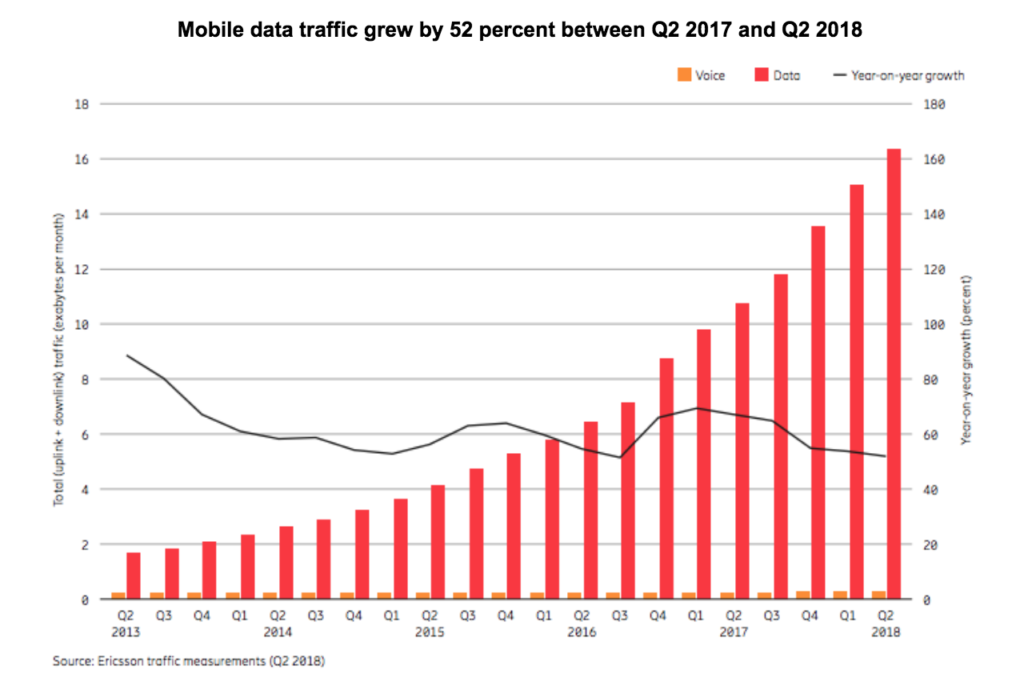
Source: Ericsson
The simple objectives of such vertical integration-deals are scale and to retain customers by expanding the control and ownership of the value chain, bundling all consumer services such as TV, Internet, Phone and OTT into one discounted package and locking the consumer in the Operator ecosystem. Recent examples of this are AT&T’s acquisition of Time Warner and Swedish Telia’s acquisition of Bonnier Broadcasting.
Through acquisitions like these, Operators can consider themselves providers of everything from infrastructure to content production and consumer technology. However, it’s important to remember that the only consistently profitable business operators have ever had is the provision of connectivity and infrastructure. There are many examples of operators who have dabbled with innovative new services in an attempt to compete head-on with start-ups when market dynamics and status quo have been disrupted. Who, for example, remembers the bold aspirations and goals of Vodafone 360? Or the ambitious operator application service platform, IP Multimedia Subsystem (IMS), which was to be a worldwide deployment of mobile telecommunications networks to offer operator-managed Video, Voice and Business services online, without forcing subscribers to change carriers.
The market, however, ended up going in a different direction, with the ecosystems eventually being controlled by Apple and Google, and OTT new entrants providing superior Voice, Messaging and Video services, as well as ease of use for consumers, bypassing any attempt of an Operator ecosystem. Now, Operators find themselves locked in cut-throat competition with these OTT challengers for what they considered their core business.
The Operators’ Gordian knot
So how then can Operators untie their Gordian knot of 1- exploding growth of mobile data traffic, 2- flat or decreasing revenue, and 3- competing with innovative and fast-moving OTT challengers? Just as Alexander the Great disentangled the impossible knot by simply cutting it loose with his sword, so should Operators. Rather than clinging to legacy market perceptions and ideas, resulting in ever more complex and unclear new initiatives, Operators should approach the issue as simply and pragmatic as possible. They should acknowledge the areas in which they excel, connectivity and infrastructure, and acknowledge what OTT challengers excel in, which is providing innovative and superior consumer services and content.
By entering into partnerships with OTT companies, Operators are able to leverage their true core competencies and provide superior customer experiences through OTT partnerships. We’re already seeing such partnerships becoming more common, with video services being the most popular area of collaboration between Operators and OTT.
Other interesting examples of partnerships are Operator investments in OTT aggregators and platforms. For example, Telia’s investment in SolidTango, enables the Operator direct access to a multitude of niche OTT services and content channels. And with the increased adoption of multiple OTT service subscriptions by consumers, as well as the growth of niche market OTT services, partnerships like these open up new levels of personalised packages that Operators could offer their customers.
Come together, right now
Operators and OTT companies are in a great position to work together and leverage each other’s strengths, rather than attempting to out-compete each other by limiting distribution or denying access to content. It is clear that what is best for consumers will in the long run also always be best for the companies serving said consumers, and those consumers are now voting more ruthlessly with their wallets than ever before. In a recent report by BCG, Video aggregators and Distributors are at risk of losing $30 Billion in profit as a result of current changes in the media market dynamics. Even though the future is still up for grabs, not all companies have the scale to keep up, and thus BCG predicts that “their best option is to pick a partner with a constellation of complementary content and assets under the best possible terms.” In the online video market of tomorrow, the writing on the wall is that Operators and OTT companies either succeed together or fail divided.
AT&T’s Randall Stephenson went on to also share his view on Netflix:
“I think of Netflix kind of as the Walmart of (video), HBO is kind of Tiffany. It’s a very premium, high-end brand for premium content.”
This is an interesting view given that Netflix received 118 Emmy nominations this year, which was more than HBO. Netflix will also spend 3x times as much as HBO on content productions this year. It would be interesting to know how Stephenson defines the high-end difference between Netflix and HBO. It does seem AT&T is committed to trying yet again to untangle their Gordian knot in a conventional way, but if it didn’t work before, will it work now?
Competing in OTT Video: How I learned to stop worrying and love niche content
The global OTT video market is growing faster than ever before, but for OTT services the battle hardens every day for subscriber wallet share and viewing time. Of the usual suspects Netflix, Amazon, Hulu and HBO, all take top spots in services ranking according to the OTT Video Market Tracker Top 10 survey, conducted by research firm Parks Associates.
OTT Video Market Tracker Top 10
- Netflix
- Amazon Video (Amazon Prime)
- Hulu (SVOD)
- MLB.TV
- HBO Now
- Starz
- YouTube Red
- Showtime
- CBS All Access
- Sling TV
Source: Parks Associates
In the US alone, there are now more than 200 subscription video services, and in Europe more than 450 OTT video services as of 2017. For new OTT services, this presents challenges. Successfully building a subscriber base in a competitive market now requires having a clear differentiator and value proposition.
A bright spot though for US markets is that more than half of all broadband households are opting to subscribe to multiple OTT services, with 15% subscribing to three or more. Even better for an OTT video service looking to take the seat next to Netflix and HBO at the OTT bundle table, this 15% segment is also the fastest-growing one according to research.
Not number 1? Then be number 3 or 4
In Europe and the US market, the foundation of all OTT service bundles for the average subscriber will in almost every case be Netflix, HBO, and Hulu, with the addition of an OTT provider of premium sports content depending on customer segment. This means that for the rest of the market, the fight is on for grabbing the number 3, 4 or even 5 spot.
To achieve this, an OTT video service will need to deliver strategies that set them apart from the competition. Content is arguably the best way to do this. Niche content in particular that caters to a smaller subscriber base, that is more loyal and dedicated than the general content consumer crowd, could be the answer. Examples of this working successfully are Magine Pro partners, Passionflix who offer niche exclusive and original romantic content and Docsville offering premium documentary content.
There’s still an opportunity to find your niche in the market through local or regional content, overlooked sports content for dark markets (markets for which there are sports rights but not being distributed), or even niche sports. Formula 1, for example, is now launching its standalone OTT subscription service for which it anticipates as many as five million potential subscribers and an annual income of $500m, or the global OTT service Hayu, focusing purely on reality show content.
Leverage your Strengths and Choose your Battles

Digital TV Europe Annual Industry Survey 2018
Acquire and retain subscribers in a competitive market by focusing on niche or exclusive content. Digital TV Europe recently released their annual industry survey in which 62.9% of the respondents agreed, original content that’s not available elsewhere is the most compelling reason to sign up to an OTT service. This mirrors a similar survey carried out by New York-based consulting firm, Activate Inc. where 45% of respondents said that original content was extremely or quite important for keeping a Netflix subscription.
But smaller, niche OTT services shouldn’t try to compete head-on with the likes of Netflix or HBO, as few can match their financial muscle for marketing and content. Instead, take a lesson from biblical David and compete on your own terms, leveraging your strengths to bring down the mighty Goliaths of Netflix and HBO.
The Content Echo Chamber

Digital TV Europe Annual Industry Survey 2018
Digital TV Europe’s annual survey also showed that long-tail content works best on an OTT service. Results show, 55.8% of respondents believe on-demand long-tail content is the most effective for OTT services as well as niche interest/long-tail linear TV channels at 40.3%.
This indicates that there is still plenty of room in the market for OTT services offering niche movie content, attracting viewers that are not fully satisfied by Netflix or others. In fact, in the last two years, Netflix has reduced their film library by 33% and its television shows by 26% according to a report by AllFlicks. Netflix’s decision to reduce its libraries in favour of a more streamlined content offering is a direct result of its analysis of viewer behaviour. However it can be risky to rely on data to dictate content production and procurement decisions. Content will start to fall under the mandate of the majority, as Netflix will only produce and distribute content that is watched by the masses, and the masses will only watch the content produced and distributed by Netflix, creating a self-perpetuating content echo chamber.
This, however, creates ample opportunity for niche OTT services to step in. The incumbents like Netflix, Hulu, and Amazon are already starting to feel the heat from new competitors that offer exclusive content according to the consulting firm Activate Inc. as the growth of SVOD services in the US has slowed considerably over the last year as the competition intensifies.
New Markets, New Opportunities
It’s also worth pointing out that the APAC (Asia Pacific) market should be of special interest for new entrants. In the next five years, tremendous growth is expected in the region thanks to increased mobile adoption, amplified broadband expansion, and enhanced purchasing power, creating a new battleground for new OTT entrants and established players alike.
There are interesting times ahead for the OTT industry, and we’re just getting started! Magine Pro offers new entrants or established players anywhere in the world, the possibility to hit the ground running with a trusted and proven OTT video service. Our experience in the consumer market means we know what it takes to beat the competition and can help you succeed. Check our products and case studies to learn more about Magine Pro and how we’ve helped others get their OTT business off the ground.
If you want to learn more about Digital TV Europe’s annual industry survey and the findings, check out our roundup and download the full report here.