
The Hidden Cost of Context Loss in OTT Operations
Every OTT team aims to move fast. But speed alone isn’t enough if teams are constantly forced to stop, clarify, or rebuild missing information. One of the most overlooked barriers to operational efficiency in streaming is context loss: the gradual erosion of meaning as work passes between tools, teams, and systems.
It’s a challenge we hear about often from streaming companies of all sizes. Whether it’s a content issue, a billing query, or a technical fault, too much time is lost piecing together the full picture. Context, which should flow naturally through workflows, is often scattered, outdated, or inaccessible.
This blog explores how context loss undermines efficiency and what a modern OTT platform can do to fix it.
How Context Disappears
Context is what allows people to make decisions quickly and confidently. It’s not just data, it’s the meaning behind the data. And in most OTT operations, that meaning gets diluted every time there’s a handoff.
A support ticket might start with a user reporting a playback issue. But for the support agent to understand what really happened, they need to access subscription status, device logs, network diagnostics, and content metadata. Each of these is typically stored in different places. The information exists, but it isn’t connected. So they rebuild the story manually.
This happens across departments too. When you have a new movie or episode to put live, there will be concerns about metadata and artwork, but also video files to encode, not to mention negotiations and checks on platform rights and licensing windows. For all but the very smallest streaming services, this is the work of several different people or teams. They’re working toward the same goal, but each sees the task through a different lens. Without shared context, assumptions multiply and momentum slows.
The Cost of Fragmented Tools
Many OTT services work with a stack of systems that weren’t designed to talk to each other. CDNs use one set of metrics, CMS tools use another to track content through the supply chain, and the analytics platform also has its own figures. Support systems log issues using another taxonomy entirely. These systems may all function well in isolation, but they create friction when progress depends on information that spans them.
When teams have to translate between systems, decisions become slower and riskier. Even worse, they’re often made based on incomplete or inconsistent views of what’s really happening.
Rebuilding Context Takes Time
The real cost of context loss is cumulative. A product manager double-checks metadata. A QA team revalidates assets before delivery. A support team replays the same investigation multiple times for similar tickets. These tasks feel necessary, and often they are, but they’re also symptoms of a deeper problem: context isn’t preserved or delivered in the right way.
Over time, these small inefficiencies add up to slower launches, higher support costs, and internal frustration. Teams spend too much time looking backwards, reconstructing what should already be at their fingertips.
What a Good Platform Can Do
A well-designed OTT platform should help preserve and deliver context throughout the content and customer lifecycle. This doesn’t mean centralising all data in one dashboard. It means making sure each team sees the right information, in the right format, at the right time.
That might include showing support agents a timeline of relevant events for a customer issue. Or helping publishing teams to view content status with licensing, technical, and editorial flags in one place. The goal is to reduce manual effort and eliminate the guesswork that comes from working with partial information.
Where AI Fits In – And Where It Doesn’t (Yet)
There’s no shortage of AI conversation in the streaming space – IBC 2025 showed that artificial intelligence is still the industry’s biggest buzzword. But in our view, the most practical and valuable use of AI is in helping teams work with better context.
Imagine an AI assistant that notices five customers reporting similar playback issues, and correlates them with a spike in edge latency on a specific CDN node during a particular device rollout. That kind of correlation saves time and directs teams to the real issue faster.
This doesn’t mean replacing human decision-making. It means using AI to highlight patterns, reduce noise, and make it easier to see what’s important. At Magine Pro, we’re focused on adding AI tools that support context awareness, but we’re not forcing automation into our OTT platform for its own sake.
Turning Context into Competitive Advantage
Preserving context isn’t just about speeding up operations. It also improves decision quality, reduces churn, and enables teams to focus on higher-value work. When context flows smoothly across your organisation, your platform becomes easier to manage, problems are resolved faster, and teams make better use of their time. That frees up your staff to focus on your strategic priorities, like tackling subscriber churn and boosting user retention.
As OTT services scale, this kind of efficiency becomes essential. The complexity doesn’t go away, but with the right platform, the burden of managing that complexity doesn’t have to slow you down.

For a deeper dive into how context becomes king in OTT, and why context is sometimes more important than content, read the original article our CEO, Matthew Wilkinson, wrote for the IABM Journal in September 2025 on page 104, exploring how context-aware workflows can unlock smarter decisions across the entire OTT supply chain.
IBC 2025 Recap: AI, Efficiency, and What’s Next for OTT
September is always a big month in our calendar as the team heads to Amsterdam for IBC. This year, the show was buzzing with conversations that will define the future of streaming. Across panels, meetings, and chance encounters in the halls, two themes stood out above the rest: AI and efficiency.
On AI, the tone had shifted – less hype, more substance. Real-world use cases are starting to make a difference in content discovery, personalisation, and operational workflows. As our CEO, Matthew Wilkinson, explained, “Agentic coding lets us move from months to days for major features. There’s always a human in the loop, but the product life cycle accelerates dramatically.”
Efficiency was the other major focus, with operators looking to do more with less while maintaining a great viewer experience. It’s also an area we’ve been focusing on at Magine Pro. As Matthew noted, “We’ve completely re-engineered the console to give operators more context across their service, helping them move faster, make better decisions, and introduce more automation.”
At Magine Pro, we see these themes play out every day with the streaming services we support. Whether it’s helping niche brands scale globally or enabling established operators to launch new offerings quickly, the message is clear: efficiency is no longer optional; it’s essential.
Here are some of the highlights and takeaways from IBC 2025.
From the Stand to the Riverside
Our stand at IBC was buzzing with activity from start to finish. We hosted both scheduled and walk-in meetings, showcasing demos of our platform across multiple devices and walking visitors through our powerful CMS console. Conversations were wide-ranging, from launch strategies and monetisation models to how operators can deliver better experiences, faster, and at scale.
But IBC is always about more than what happens on the show floor. This year, we were proud to co-host an evening by the riverside at Rijnbar, celebrating innovation and collaboration with our partners Marketlyft, Lighthouse Growth, Stockholm Stream, and Bunny.net. It was a fantastic opportunity to step away from the bustle of the RAI, reconnect with familiar faces, and spark new ideas for the year ahead.


Sharing Industry Insights at IBC
Meanwhile, our CEO, Matthew Wilkinson, contributed to industry thought leadership in two key ways. His article, “Context is King”, was published in the IABM Journal, which you can now read online on page 104. He also joined an IBC panel with XRoadMedia and ADB SA on “Combatting churn through smarter engagement and personalisation,” where the discussion focused on practical ways streaming services can retain and re-engage subscribers.
The session explored how shifting viewing habits, subscription fatigue, and the rise of direct-to-consumer models are reshaping retention strategies. As Matthew explained, many services are now looking beyond short-term promotions to create lasting value: “Post-COVID we see subscription fatigue. The best thing to prevent churn in a subscription service is to get people to lock in and take a yearly subscription. When you have big shows and big releases, run campaigns around your content bundling and offering.”
The panel agreed that while content is still the biggest driver of loyalty, how it’s packaged, released, and promoted ultimately determines whether viewers stay engaged or switch away. You can watch the full discussion below.

IBC is only the start of the conversation. Next up, we’ll be in Cannes for MIPCOM, meeting content owners and operators to explore how we can help distribute exclusive content, launch branded streaming services, and grow audiences worldwide. If you didn’t catch us in Amsterdam, we’d love to see you in Cannes. Book a meeting here.
Preparing for the Next Wave of Smart TVs: How to Navigate OS, AI, and UX Trends
In the battle for eyeballs, the big screen seems to be winning. YouTube’s CEO, Neal Mohan recently confirmed that TV screens have overtaken mobiles as the primary device for YouTube viewing in the US. And while the US leads the way, this shift is happening globally. Research from Ampere Analysis (Feb 2025) shows 76% of internet users in Europe now own a Smart TV. That’s a 25% increase over the past three years, mirroring a 25% rise in share of viewing for these devices since 2021.
At Magine Pro, we’ve been developing Smart TV streaming apps for over 12 years, giving us a front-row seat to this transformation. As more consumers shift to the big screen, we hear one major concern from OTT service providers: How can they stay ahead of the curve when Smart TV technology is so fragmented and constantly shifting?
Every year, CES and other tech expos are filled with announcements from giants like LG and Samsung showcasing features and upgrades aimed at driving consumer TV sales. Meanwhile, the already crowded Smart TV OS landscape keeps expanding. How are OTT services supposed to keep up? Should they invest resources into supporting multiple operating systems for reach, or focus on the latest trends to future-proof their apps?
To help answer these questions, I’ll break down some of the biggest trends likely to shape the industry in the next few years. Importantly, I’ll look at how smaller OTT services can prepare for them. In this blog I’ll explore:
- AI-Based Upscaling
- Auto-Translation
- Voice & Gesture-based Control
- Emerging Operating Systems
If you’re reviewing your OTT service’s Smart TV strategy, you can also download our e-guide: Go big or stay small? Why the Smart TV experience is essential for online streaming services.
Now let’s get stuck into those emerging trends!
AI-Based Upscaling: Seamless Smart TV UX Without The Compromises
For years, Smart TV app performance has been constrained by device limitations, bandwidth restrictions, and processing power. High frame rates, smooth animations, and seamless transitions require significant resources. As developers, we’re often forced to sacrifice visual fluidity to maintain stability across different TV models. But AI-based upscaling is set to change that, shifting the burden of performance optimisation from app developers to TV hardware itself.
AI-powered upscaling, like Nvidia’s DLSS (Deep Learning Super Sampling), has already transformed the gaming industry, using machine learning to boost resolution and frame rates in real-time. Now, Smart TV manufacturers are integrating similar technology to fill the gaps in frame rates and motion smoothness. This means that an app running at 30 frames per second (FPS) today could soon appear just as fluid as a 50FPS app, without developers needing to rewrite code or optimise animations for every individual device.
At Magine Pro, we see this as a major leap for OTT UX on Smart TVs. Historically, upscaling on TVs has focused only on the video, forcing app developers to strike a balance between animation quality and responsiveness in the UI, sometimes choosing simpler transitions or reducing visual effects to maintain app stability. With AI-enhanced motion processing becoming standard in new TVs, we expect this to allow for more upscaling in the app UI, allowing the next generation of streaming apps can be more dynamic, visually polished, and immersive, without compromising performance.
Key Takeaways for OTT Services
So what does this mean for OTT providers currently planning their Smart TV strategy? You can afford to focus less on maxing-out your FPS across multiple TV platforms to compete with the big names in streaming. Concentrate instead on creating consistent, scalable experiences and building engaging, visually rich interfaces, knowing that AI will handle the performance lift on supported devices. As AI-based processing becomes the norm, even smaller streaming services will be able to deliver a premium app experience, without the premium engineering overhead.
It’s not just about smoother UI animations. AI-powered upscaling could transform how OTT services approach video delivery for Smart TVs. If the TV itself can take lower-resolution streams and enhance them to near-4K or even 8K quality, operators can optimise their encoding strategy accordingly to cut CDN costs without sacrificing viewer experience.
On-Device Subtitle Translation: Lowering Barriers to OTT Localisation
Localisation has long been a challenge for OTT services expanding globally. Now, once again, hardware integration with AI could alleviate some of the hard work for content owners, getting the Smart TV hardware to perform automated, real-time translations directly on the device.
AI-driven translation tools are already familiar in web browsers. Now Smart TV manufacturers are beginning to integrate real-time subtitle translation directly into their operating systems. This means that rather than requiring streaming services to upload a separate subtitle file for every supported language, TVs will be able to dynamically translate dialogue into the viewer’s preferred language on the fly.
For OTT providers, this could significantly reduce localisation overhead—especially for smaller services looking to scale quickly into new markets. Instead of managing, storing, and encoding hundreds of subtitle variations, services could rely on the TV’s built-in AI to generate subtitles in real-time, unlocking faster time-to-market for new territories.
However, this shift comes with new UX considerations. If Smart TVs are generating and overlaying subtitles at the OS level, OTT services must ensure that their UI design doesn’t create conflicts. If a platform hardcodes subtitles into the video stream or places on-screen graphics in common subtitle areas, there’s a risk of clashing visual elements—leading to a messy, unreadable experience for viewers.
Key Takeaways for OTT Services
At Magine Pro, we know Smart TV apps must be built with flexibility in mind, ensuring subtitle placement adapts dynamically to maintain a consistent UX on all devices as individual manufacturers change their functionality. With Magine Pro’s white-label OTT platform, streaming services get expert guidance on Smart TV UI adaptations, ensuring their apps remain consistent and future-proofed as on-device AI capabilities evolve
While the AI-powered upscaling we already covered is an easy win for streaming services, AI-generated translations introduce a new layer of complexity. Generative AI is still imperfect, and OTT providers will need to weigh the benefits of rapid market expansion against the potential risks of inaccurate subtitles.
Voice and Gesture Control: The Future of Hands-Free Smart TV Navigation
For decades, the TV remote control has been the primary way viewers interact with their screens. But as Smart TVs become more sophisticated, voice and gesture-based navigation will revolutionise how users browse and control streaming apps. While these technologies are still evolving, major Smart TV manufacturers are already investing in AI-driven interfaces that allow users to interact with their TVs in more natural and intuitive ways.
Voice control is already mainstream – AI assistants like Alexa and Siri are now household names. On Smart TVs, voice-enabled remotes now let users search for content, change channels, and control playback with simple voice commands. Some platforms now also use camera-based tracking or motion sensors to allow viewers to navigate menus with hand movements instead of button presses. LG’s Magic Remote, already supported in the Magine Pro OTT Platform, is a step towards this, allowing users to employ their remote control like a mouse rather than being restricted to sequential up-down-right-left navigation.
Both voice and gesture control offer convenience and, for those who struggle to use traditional remotes, accessibility. However, there are still significant challenges with these technologies, especially when it comes to accuracy, consistency, and user adoption.
New search and navigation methods may require a rethink on button layouts, hover states, and menu navigation to accommodate touch-free interactions. Gesture-based navigation could also introduce new UX challenges, such as avoiding accidental selections or ensuring that on-screen prompts guide users effectively.
Key Takeaways for OTT Services
At Magine Pro, we believe OTT services should monitor these developments closely and ensure their apps are designed with flexibility to accommodate future interaction models. Since these technologies are still evolving, smaller OTT services should wait for greater standardisation before investing heavily. For now, it’s important to focus on creating clear, structured UIs that are adaptable to evolving Smart TV capabilities, as well as concentrating on improving metadata to power voice search and ensure content can easily be found by voice assistants. As an added benefit, the metadata work will also enhance personalised content recommendations for increased engagement in the shorter term.
Navigating The Shifting Smart TV OS Landscape
One of the biggest challenges for OTT service providers is keeping up with the fragmented Smart TV operating system (OS) landscape. With Samsung’s Tizen, LG’s webOS, Vizio, Roku, and Android TV, plus a steady stream of new or proprietary OS announcements, it’s difficult to predict which platforms will gain traction and which will fade into obscurity.
Each OS has its own development requirements, UI constraints, and feature set, making it costly and time-consuming for streaming services to build and maintain native apps for every platform. Additionally, while major players like Samsung and LG are working toward better standardisation, Smart TV platforms still have inconsistencies—from differing CSS rendering engines to unique input navigation behaviours.
Key Takeaways for OTT Services
For OTT providers, the key to future-proofing against OS fragmentation is flexibility. Instead of committing to bespoke app development for every new platform, a modular, scalable approach ensures that apps can adapt quickly as new operating systems emerge.
At Magine Pro, we solve this challenge by providing a single-codebase solution that supports multiple Smart TV platforms, ensuring a consistent user experience across devices. By focusing on cross-platform compatibility, streaming services can avoid getting locked into the complexities of individual OS ecosystems and instead scale efficiently as the market evolves.
Want to know how Magine Pro customers like Passionflix approach Smart TV apps? Download our e-guide: Go big or stay small? Why the Smart TV experience is essential for online streaming services.
Innovation Stations! Magine Pro Hack Days Focus on OTT AI Technologies
Magine Pro recently challenged its brilliant team of people to come together in cross-functional teams and create something new for our platform in a series of Hack Days on the theme of OTT AI. In this blog, Hayley Barnes reflects on the amazing creativity and teamwork shown, and how it underlines our commitment to innovation.
Artificial Intelligence is, without doubt, the buzzword of the decade for a whole host of industries, including Media and Entertainment. But many companies are still struggling to see how AI can actually advance their goals, rather than being just a gimmick.
That’s why we gave our teams a specific AI-based challenge for this year’s Magine Pro Hack Days. We knew our fantastic team of specialists would come up with some amazing suggestions of how AI could enhance our OTT platform and, crucially, improve the viewing experience and encourage engagement from end consumers, because that’s what our customers, the video service providers, really care about. And we were right!
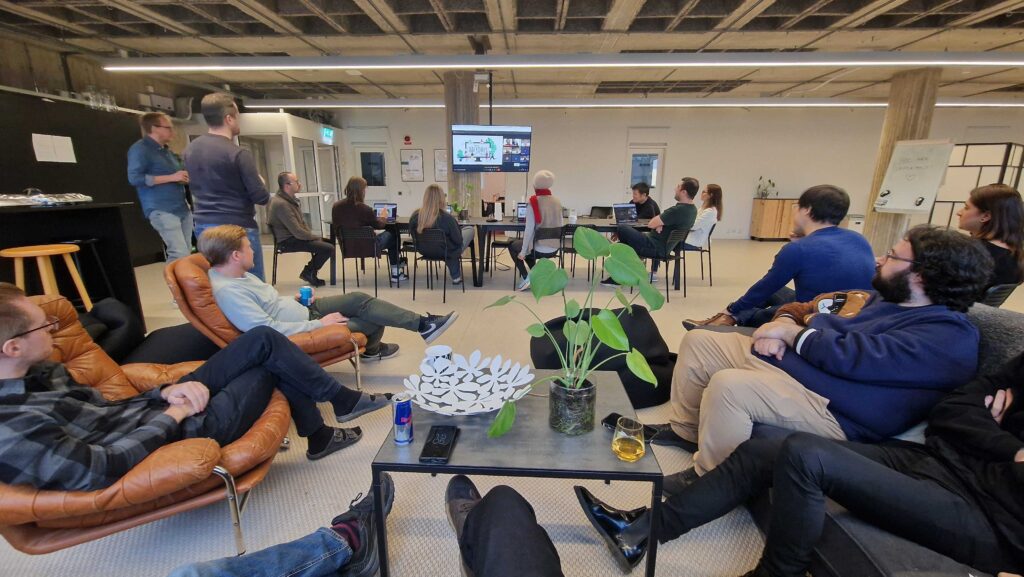
The Magine Pro team enjoying the Hack Days presentations
OTT Innovation in action
In total, nine fantastic proof of concepts came to life, each showcasing the creativity and technical prowess of our teams. The diversity of projects was really inspiring and demonstrated the flexibility of the Magine Pro OTT platform.
We had two joint winners: The first implemented AI from Amazon Transcribe to automatically add subtitles to VOD content. They shared the honors with the cleverly named “TrivAI” which used OpenAI’s APIs to generate a trivia quiz based on VOD content to encourage viewer engagement.

Promoting an accessible and consistent OTT user experience with subtitles
The team behind the subtitling project found a speedy way to trigger not only the transcription of speech from the VOD files, but also the conversion to SRT file types that could then be uploaded to the relevant Magine Pro workflow for automatic display in the end-user’s video player. This would be a huge benefit for OTT services that currently disappoint viewers with only patchy subtitling coverage.
 For the lowdown on this project, I spoke to Streaming Software Engineer, Catuxa Seoane Botana who was taking part in her first Magine Pro Hack Days after joining us almost a year ago. “The biggest challenge was taking the words and timestamps output by the AI and turning them into sentences with correct punctuation,” Catuxa told me. “The breakthrough moment when we successfully created an SRT file from an MP4 video was very exciting.”
One key criteria for the team was that they wanted to create something seamless that built on the existing functions of our OTT platform. “Our focus was on creating a streamlined, automatic solution,” explained Catuxa, “That was one of the drivers behind our choice of Amazon Transcribe as our AI solution for the project. But we’re already thinking about further possibilities, including using Amazon Translate to automatically generate subtitles in multiple languages – because the more choice offered to viewers, the better!”
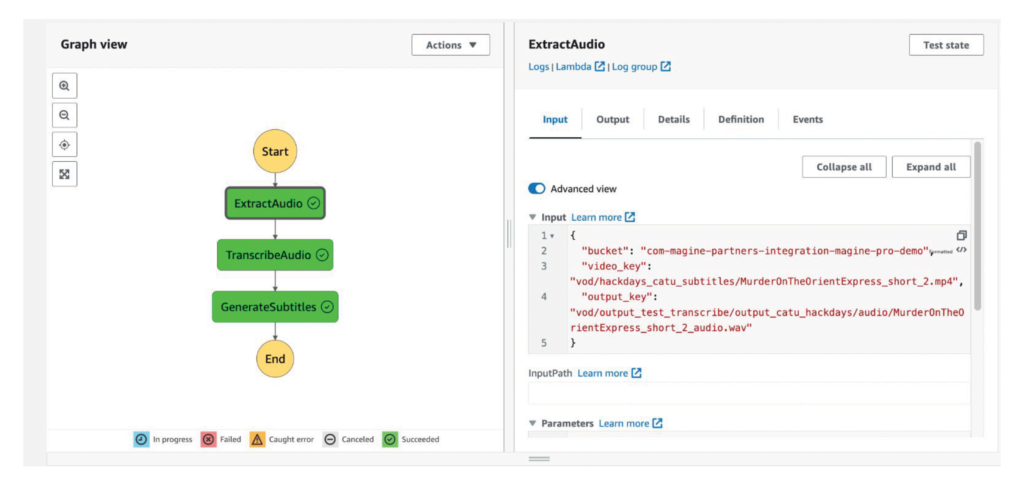
Some of the code written for the subtitling solution

Increasing OTT engagement is not a trivial matter
So what about TrivAI? This project was centered on the concept that gamification can keep users interacting with a service longer, as well as presenting a fun way to introduce users to new content that they may like to watch, both key goals for any OTT service. You’ll see from the screenshots below that the proof of concept interface included links to the trailer and also the options to add/remove the VOD content the quiz is based on to your watchlist. TrivAI team consisted of: Rami Baarah (Web Lead Engineer), David Wong (Senior Software Engineer), Saima Iftikhar (QA) & Joel Kenne-Forsberg (Product Owner)

The spokesmen for the TrivAI team was Web Lead Engineer, Rami Baarah. “The way the Magine Pro TV app is built allows us to rapidly add features and test them on actual devices,” Rami told me. “When you pair that with our flexible backend, we could really focus as a team on making the trivia game as much fun as possible, rather than fighting with the code. Once we were having fun playing the game, we knew we’d cracked it!”
But is the trivia idea just another AI gimmick? Rami doesn’t think so: “It would allow end users to explore content in a fresh way,” he believes. “It will either help them to find new things to watch, or revisiting old favourites in a fun new way. And for the OTT platforms, it’s an engaging way to retain customer attention and provide them with entertainment – which is, in the end, what their business is!”

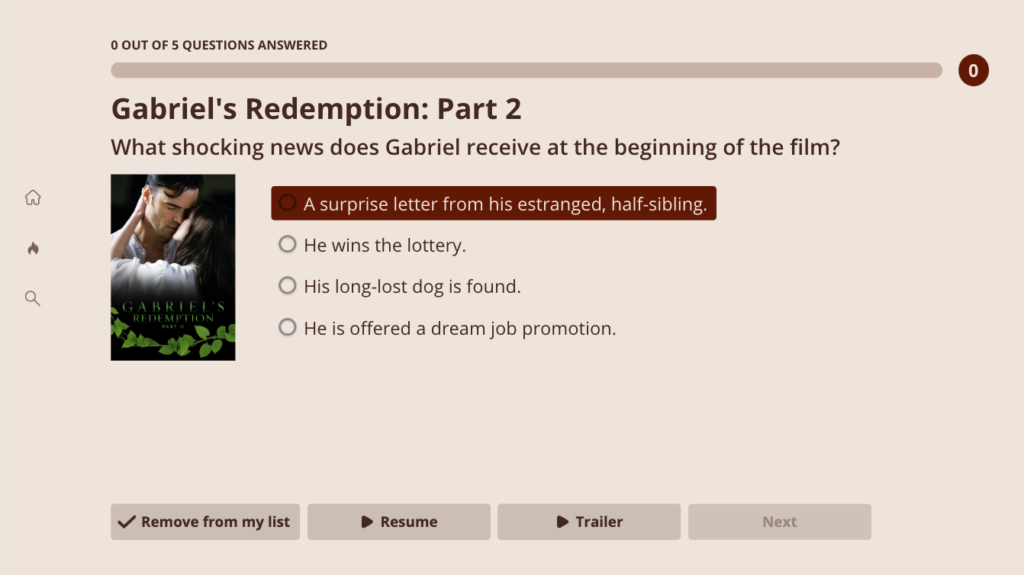
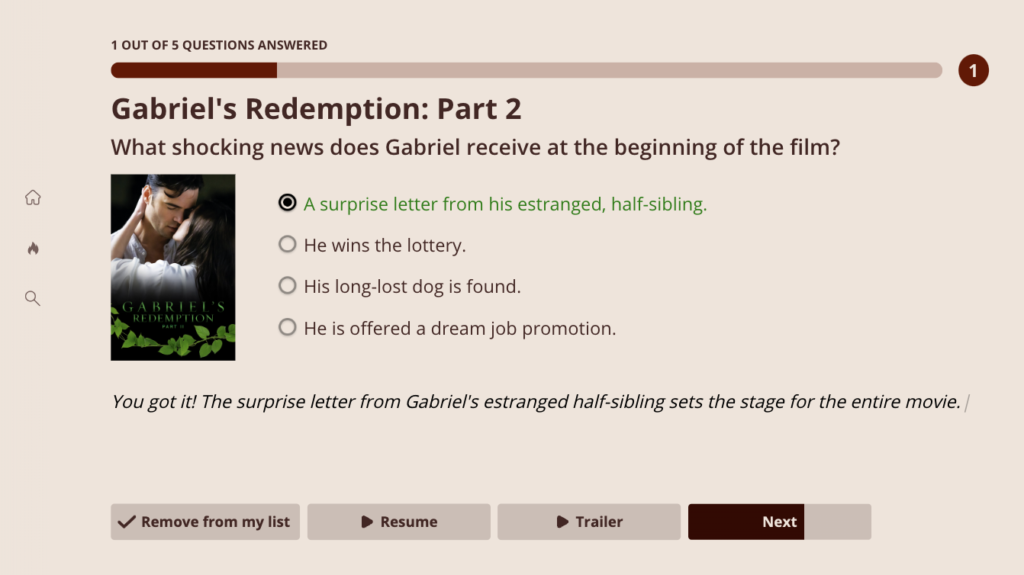
The Trivia Game proof of concept within the Magine Pro Big Screen TV app
Hack Days are fun, with a serious purpose
Our Hack Days not only demonstrate Magine Pro’s commitment to pushing the boundaries of technology but also underline our collective ability to translate ideas into tangible solutions. On a deeper level, they serve to empower our team, providing them with the opportunity to explore their passions, experiment with cutting-edge technologies, and showcase their capabilities in a supportive environment.
As Rami puts it: “It’s great to work with my regular team but also with other colleagues from across the company. It’s the spirit and energy you see in others that makes you feel confident in delivering in your day job as well as the Hack Days.”
We’re so proud of this culture of collaboration, innovation, and continuous learning that makes Magine Pro such a great place to work.
Stay tuned for some of these great projects featuring in coming releases of our OTT platform.
If you’d like to see Magine Pro in action, why not book a demo with our team?
Takeaways from CES 2024 for video service providers
The annual Consumer Electronics Show (CES 2024) always grabs global headlines with eye-catching new gadgets and ever-expanding TV screen sizes. This year was no different, with acres of coverage for LG and Samsung’s new transparent TV screens, the latest virtual reality concepts, and robots that will make you anything from a cocktail to a stir-fry.
But, like the bright lights and razzmatazz of the host city, Las Vegas, the show-floor glitz of CES 2024 is largely a temporary distraction for the video entertainment industry. Behind the scenes, there are serious conversations about the future of streaming. So what were video service providers really talking about at CES 2024?

Magine Pro’s Sales Director, Neil Fender, at CES 2024.
Interest in AI is becoming more targeted
Just as we saw at IBC and NAB in 2023, Artificial Intelligence (AI) continued to be a major buzzword. Our CEO, Matthew Wilkinson, touched on this important topic in his recent blog on Large Language Models and Generative AI. But the partners and customers (both current and future) that I spoke to in Las Vegas are increasingly focused on the practicalities of deploying this constantly evolving technology. They’ve gone beyond wondering how AI might revolutionise the industry in the future, to looking at very specific use cases that will advance their short-term goals, not just their longer-term planning.
With consumers around the world becoming increasingly cost-conscious, churn is a massive area of focus for every streaming service, no matter what combination of business models they’re using. The video services I spoke to are looking for a strong and immediate return on investment for any foray into AI. In particular, they want it to keep consumers engaged so they’re less likely to look elsewhere for content. The benefits of offering personalized content recommendations are the most often-cited strategy for growing engagement, so it was a pleasure to be able to talk about the AI-powered recommendation capabilities in Magine Pro’s end-to-end OTT streaming platform .
I was also happy to talk through some of the tactics that have paid dividends for our existing customers when tackling churn. For example, the “dunning” functionality in our advanced billing engine enables them to systematically communicate with consumers whose payment methods have expired or failed. This proactive strategy prevents passive involuntary churn, minimising customer loss and ensuring a positive user experience. Another proactive approach is to automate “win-back” strategies. This means offering targeted discounts to certain users who have recently churned, or shown signs of being a flight-risk, to help keep them on-board.
We’ll have more about these tactics in our upcoming e-guide on advanced OTT monetization strategies. Register now to be among the first to get the guide, which will also explain some of the reasons we champion hybrid monetization models.
No moving out of the FAST-lane
I don’t think anyone was surprised to find that FAST – another of the biggest streaming trends of 2023 – was still a hot topic at CES. The low barriers to entry mean that FAST channels continue to be the most popular route into the streaming market for content owners, particularly in the US market.
The FAST trend I heard most about at CES, however, was those who’ve dipped a toe into streaming with FAST channels via aggregation platforms like Roku, Amazon, LG, and Samsung and now want their own suite of streaming apps to build a direct relationship with consumers. We had some excellent conversations at CES with technology partners and customers about how we can help them make that ambition a reality with the Magine Pro OTT platform because it’s quick and easy to launch, but also customizable so it can grow with their business.


Want to know more?
If you weren’t able to make it to CES 2024, you can book a meeting with our team to talk about how AI recommendations could improve your engagement, or how Magine Pro can elevate your content distribution and monetization strategies.
OTT Industry Trends that Shaped Video Streaming in 2023
It’s proven to be a transformative year in OTT marked by rapid changes and dynamic shifts. From the widespread adoption of FAST channels to the increasing prominence of hybrid monetisation models and the transformative role of artificial intelligence (AI), the industry is witnessing a paradigm shift that will undoubtedly demand adaptation from both service providers and content creators in 2024 and onwards.
Here are our 5 noteworthy OTT industry trends and key takeaways from 2023, that are worth watching next year:

The FAST Lane to Success
The adoption of Free Ad-Supported Television (FAST) channels has continued to rise in 2023, in response to escalating churn rates. Service providers are leveraging these channels to avoid compromising revenue and retain subscribers who have become more discerning about where they invest their entertainment budgets. The significance of this trend suggests a shift in how streaming services engage with their audience, laying the groundwork for a more sustainable future.

Hybrid Monetisation Models for Sustainability
In response to the intensifying competition and the need to win back subscribers, hybrid monetisation is also becoming increasingly popular. Service providers are strategically integrating ad-supported sections into their platforms to enhance accessibility while ensuring sustainability. Even industry giant Netflix is actively exploring this avenue, underscoring the importance of striking a balance between user experience and financial viability.

TV Taking Back the Spotlight
In a surprising turn of events, the television could be on track to reclaim its throne as the primary screen for content consumption. Notably, nearly half of YouTube’s viewership now occurs on TV screens according to internal figures. This shift has profound implications for streaming providers, emphasizing the critical need for smart TV app development to secure long-term growth.

Global Expansion with Localized Cultural Content
As streaming services expand their global footprint, the demand for localised content is experiencing a surge. Viewers are increasingly seeking content that resonates with their culture, language, and preferences. This demand for diversity and inclusion is driving more and more streaming platforms to tailor their content libraries to cater to the unique tastes of different markets.
AI Transforming the OTT Experience
Undoubtedly, one of the most significant OTT industry trends of the past year is the integration of artificial intelligence into streaming. AI is not just enhancing content recommendations for users but is also expected to play a pivotal role in dynamic content creation. This enables the delivery of personalised and engaging content, keeping viewers hooked and satisfied.
In 2024, the OTT video streaming industry is poised to firmly establish and fortify these trends, promising a substantial enhancement in overall industry performance. As we navigate this evolving landscape, it becomes increasingly clear that adaptability and innovation are the cornerstones for success in this dynamic and fiercely competitive market. Streaming services must be agile in meeting evolving user expectations.
For Magine Pro, this necessitates a commitment to ongoing innovation and a steadfast focus on our OTT platform and products. By doing so, we aim to deliver optimal solutions for our customers, empowering them to seamlessly deliver their content to audiences worldwide. And ensure our clients stay ahead in an environment where meeting and exceeding user expectations is paramount.
______________________________________________________________________________________
Keen to learn more about the top OTT industry trends and how Magine Pro are navigating the changes? Get in touch with our team.
Discover more about our flexible OTT platform and how we enable our customers to monetise their live events, linear and VOD content. Visit our blog for additional insights and download our free white papers and ebooks.