When Complexity Kills Creativity: The Hidden Cost of Too Many Vendors in OTT
Does anyone start a streaming service because they’re passionate about the underlying technology? Unlikely. Most specialist streaming services begin with a love of content, a belief that a particular collection of stories deserves a home and a community built around it. But somewhere along the way, many operators find themselves spending more time managing vendors, integrations and technical firefighting than curating great content or serving their audience. It’s all too easy for a team built around creativity to end up running what feels like a mini IT department.
And this isn’t just an OTT problem. One survey of over 140 CIOs, executives in large enterprises with far more resources than most specialist streaming services, named vendor consolidation as their top strategic priority for 2025. Nearly 70% planned to reduce the number of suppliers they work with, in some cases by more than 20%. Their reasons are familiar: security, fragmentation, operational complexity and lack of cohesion across systems. If organisations with entire IT departments and security teams are actively trying to reduce complexity, the case for consolidation among smaller, content-led services is even stronger.
The Hidden Operational Tax of Best-of-Breed
The idea of “best-of-breed” technology remains seductive. Pick the best vendor for each piece of your stack, and you end up with a world-class platform, at least in theory. But in practice, especially for teams without layers of programme managers and architects, the operational cost quickly becomes overwhelming.

Magine Pro’s Head of Engineering & Operations, Marcus Lindén, has lived this reality from both sides, first at TV4 in Sweden and now as a vendor helping specialist services scale. As he puts it: “Working best of breed, you get exactly what you want, of course, but you need a big team to manage all of these vendors. If you’re on the big broadcasting side, the way to solve the complexity is to build up a big internal organisation — a hundred plus engineers working around the clock, but then you still keep all the external vendors as well. You have to coordinate the work. Even though every vendor does their best, you still need layers of programme managers and project managers just to get things done.”
Every additional vendor brings its own roadmap, requirements, timelines and integration points: each moving at its own pace. And when something breaks, accountability gets blurred very quickly. The result is an ongoing “operational tax” that eats into the time and focus needed to understand your audience, acquire great content and refine your service.
As we explored in our recent blog on operational context loss, multi-vendor setups often create gaps between systems that slow down decision-making and make it harder to run an OTT service confidently. Complexity causes delays, but also drains energy from the places where it’s most needed.
End-to-End Platforms: One Partner, One Place to Run Your Service
 This is where an end-to-end approach has clear value: fewer vendors to manage, fewer handovers, and far less room for gaps in understanding or responsibility. When Magine Pro’s CEO, Matthew Wilkinson, talks about the impact this has for operators, he brings the conversation back to clarity and accountability. “If you work with lots of individual suppliers, they’re very siloed. They focus on what they do, but they may not be taking into consideration the end-to-end chain. At Magine Pro, we handle the end-to-end chain, so there’s a one-stop shop for fixing problems. You don’t need to go to one vendor who points to another, who points to another.”
With an all-in-one platform, operators gain a single operational view of their content catalogue, user lifecycle, billing, product configuration and performance. There’s no guesswork about where something lives or whose system needs to be updated.
Magine Pro’s Console is central to that simplicity. It brings together the everyday tasks that keep an OTT service running: managing catalogue items, setting up service plans, monitoring churn signals, supporting customer journeys and controlling billing, all in a single interface. For specialist services such as Passionflix, Splatter or Filmicca, this frees up the time and headspace needed to focus on the audience and the stories that matter to them.
Agentic Coding: Speeding Up Innovation Without Increasing Workload
Of course, simplicity alone doesn’t solve the competitive challenge. Specialist streaming services still need to move quickly. They must continue launching new features, adapting to viewer behaviour and staying on par with the global innovators like Netflix or Disney+ who set audience expectations.
This is where Agentic coding has reshaped the pace of development within Magine Pro’s engineering teams. It’s not about bolting on eye-catching AI features; it’s about accelerating the entire cycle from idea to customer feedback. As Matthew explains, “Before, we may have taken a couple of months to get a big new feature out and then get the customer feedback. Now, you can do that in a matter of days.”
“Early customer feedback is always helpful,” agrees Marcus. “Being able to get mockups, prototypes and test versions into their hands quickly makes a real difference.”
For specialist streaming services, this speed creates a more responsive, less resource-intensive way to evolve. Teams don’t need a large internal engineering function to keep pace with change; they need a partner who can deliver improvements quickly and consistently.
Security: The Quiet Risk Behind Vendor Sprawl
The CIO research that highlighted vendor consolidation also pointed to another growing concern: security risk increases with every supplier added. Each integration introduces its own permissions, tokens, maintenance windows and vulnerabilities.
For specialist streaming services, security threats, from piracy to credential theft, are business-critical and something they’re unlikely to be equipped to tackle in-house. As Marcus explains in his deep dive into OTT security, protecting a platform requires consistency, oversight and clear responsibility. Those things are far harder to maintain when systems are distributed across multiple vendors. “In a smaller service provider, there are fewer resources”, says Marcus. “The problem we solve for them is that they don’t need additional resources to manage us. They’ve got one interface to handle everything.”
Simplification should be a core OTT security strategy.
Creativity Thrives When Complexity Doesn’t
Specialist streaming services succeed when they can focus on what makes them unique: the content they champion, the editorial choices they make and the communities they build. But that only happens when teams have the space to think, experiment and create. Complexity shrinks that space; simplification opens it back up.
End-to-end platforms like Magine Pro, combined with unified operational tools and Agentic development, give streaming services the freedom to concentrate on their core strengths, rather than the machinery behind the scenes.
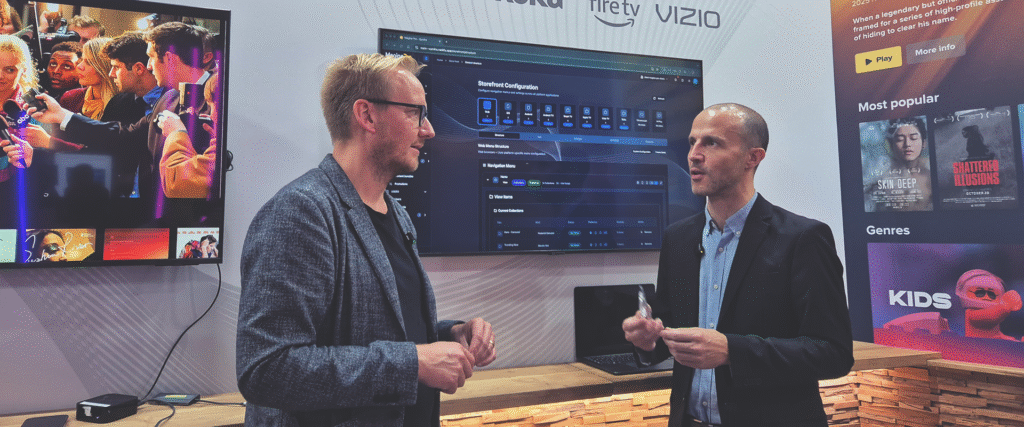
If you want to hear Matthew and Marcus discuss these themes in more depth, watch the full conversation between them here.
Or, if you’d like to talk to our team about how Magine Pro helps specialist streaming services focus on what they do best, book a meeting with us here.